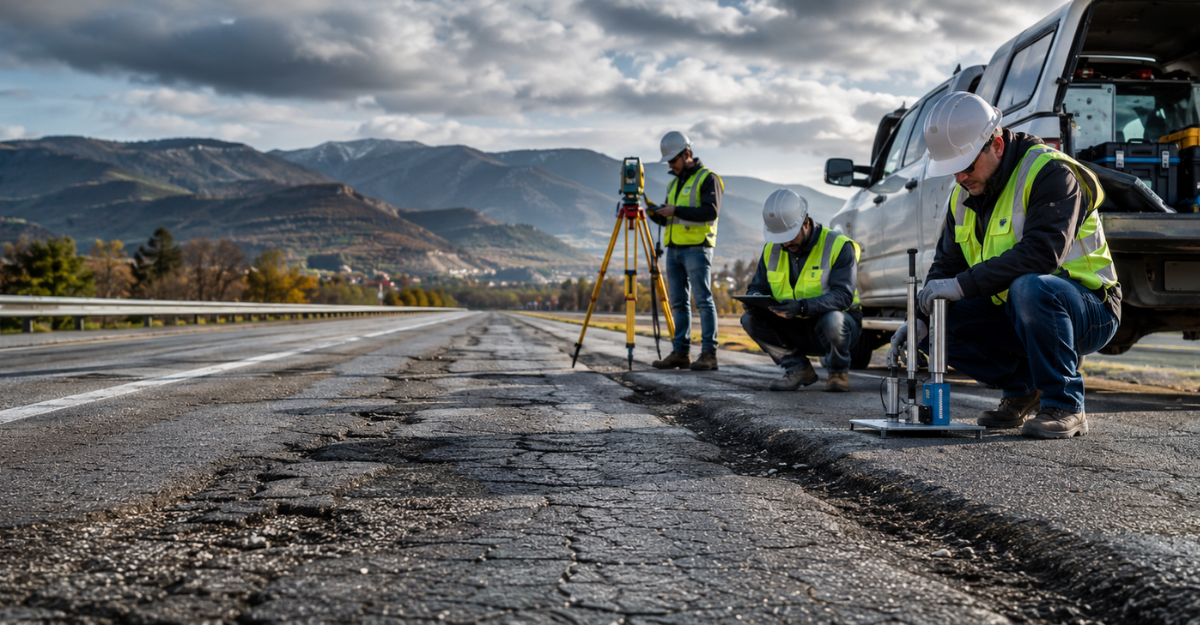
Road cracking, potholes, rutting, or subsidence can have multiple causes — some from surface deterioration, others from problems deep within the pavement structure. Repairing without sufficient inspection data risks choosing the wrong method, leading to repeated damage at the same location and escalating maintenance costs over time.
ทำไมการซ่อมถนนโดยไม่ทดสอบจึงมีความเสี่ยง?Why Is Repairing Roads Without Testing Risky?
Road repair is often decided based on what is visible — a crack gets patched, a pothole gets filled, an uneven surface gets overlaid. But visible damage is often just a "symptom" of a deeper problem. If the root cause lies in the base layer, subgrade, subsurface void, or drainage, surface-only repair cannot deliver a lasting fix.
If the root cause lies in the subgrade, base layer, subsurface void, or drainage system, surface-only repair cannot provide a permanent fix — and the road will fail again in the same location before long.
ปัญหาที่มักเกิดขึ้นเมื่อซ่อมถนนผิดวิธีCommon Problems from Incorrect Road Repair
1. ถนนกลับมาแตกร้าวซ้ำในตำแหน่งเดิมRepeated Cracking at the Same Location
If cracking stems from a weakened pavement structure or a subgrade with insufficient bearing capacity, patching or overlay alone provides only short-term relief — repeated traffic loads cause the original cracks to reflect back through the new surface.
2. ซ่อมแล้วถนนยังทรุดตัวต่อเนื่องOngoing Subsidence After Repair
Road subsidence is often linked to soft soil, inadequate compaction, groundwater, or subsurface voids. Without identifying the true cause, repairing only the top surface cannot stop settlement occurring in the layers below.
3. ใช้งบประมาณซ่อมบำรุงมากกว่าที่ควรOver-Spending on Maintenance
Without inspection data, repair decisions can go in either direction — under-repair leads to repeat failures, while over-repair wastes budget. Engineering testing enables the right scope of repair, making every maintenance baht count.
4. กระทบต่อแผนงานและการจราจรDisruption to Schedules and Traffic
Frequent re-repairs affect road users, contractors, and project owners — in time, traffic closures, safety, and project reputation. Pre-repair testing reduces rework risk and enables better maintenance planning from the outset.
การทดสอบถนนช่วยให้ซ่อมถูกจุดได้อย่างไร?How Does Road Testing Enable Targeted Repair?
Road testing shifts decision-making from "guessing" to "data-driven judgement" — giving engineers the information needed to answer key questions before repair begins:
ถนนเสียหายจากผิวทางหรือโครงสร้างชั้นทาง?Is damage from the surface or from the structural layers?
ชั้นทางยังรับน้ำหนักได้ดีหรือไม่?Can the pavement structure still handle the load?
มีโพรงหรือความผิดปกติใต้ผิวถนนหรือไม่?Are there voids or anomalies beneath the surface?
พื้นผิวถนนมีความเรียบตามเกณฑ์หรือไม่?Does the road surface meet smoothness standards?
ควรซ่อมเฉพาะผิว เสริมชั้นทาง หรือปรับปรุงโครงสร้างใหม่?Should repair be surface-only, base rehabilitation, or full reconstruction?
With this data, engineers can select the most appropriate repair method, reduce the risk of misdiagnosed repairs, and extend the effective service life of the road.
เครื่องมือทดสอบที่ช่วยวางแผนซ่อมถนนTesting Instruments for Road Repair Planning
FWD evaluates pavement structural strength by simulating wheel-load impact and measuring deflection — data used to analyse the load-bearing capacity of each pavement layer.
FWD data supports overlay design, remaining life assessment, and structural rehabilitation planning — suitable for highways, major roads, airport pavements, and industrial roads. See equipment: Falling Weight Deflectometer
GPR performs non-destructive subsurface surveys using electromagnetic waves — detecting voids, pipes, cables, or material layer changes beneath the pavement without any excavation.
Road Profiler เป็นเครื่องมือที่ใช้ตรวจวัดความเรียบของผิวทางและวิเคราะห์คุณภาพการขับขี่ เช่น ค่า IRI (International Roughness Index) หรือค่าความขรุขระของถนน
Road Profiler measures surface smoothness and ride quality — including IRI (International Roughness Index) and related pavement roughness metrics.
Road Profiler data supports pavement condition assessment, maintenance prioritisation, and systematic quality acceptance for new construction or rehabilitation. See: Road Condition Survey
LWD tests the bearing capacity of soil or pavement layers in the field — ideal for construction quality control of fill soil, sub-base, or base layers before paving.
การใช้ LWD ช่วยให้วิศวกรตรวจสอบคุณภาพของชั้นทางได้รวดเร็ว ลดความเสี่ยงจากการก่อสร้างบนชั้นทางที่ยังไม่พร้อม และช่วยป้องกันปัญหาถนนเสียหายในอนาคต ดูเครื่องมือ: Light Weight Deflectometer และ Field Test Equipment
LWD enables rapid layer-quality verification, reducing the risk of building on unprepared layers and preventing future pavement failure. See: Light Weight Deflectometer and Field Test Equipment
5. เครื่องมือทดสอบความหนาแน่นและคุณภาพวัสดุภาคสนามField Density and Material Quality Testing
Beyond structural assessment, field density and material testing instruments play a vital role in quality control — verifying the compaction of soil, aggregate, or base layers during construction.
หากการบดอัดไม่เพียงพอ ถนนอาจเกิดการทรุดตัวหรือเสียรูปได้ในระยะยาว การตรวจสอบคุณภาพตั้งแต่ระหว่างก่อสร้างจึงเป็นขั้นตอนสำคัญในการลดปัญหาซ่อมซ้ำในอนาคต ดูหมวดเครื่องมือ: Field Test / QC Equipment
Insufficient compaction leads to long-term settlement and deformation. Quality verification during construction is a critical step in preventing future repeat repairs. See: Field Test / QC Equipment
ซ่อมถนนแบบมีข้อมูล ดีกว่าซ่อมจากอาการที่มองเห็นData-Driven Repair Is Better Than Repairing from Visual Symptoms
Damaged roads can look similar but have very different causes — some cracking comes from surface deterioration, while other cracking originates from a weak base layer below. Relying on visual inspection alone is often insufficient for effective repair.
Engineering testing reveals data deeper than the road surface — enabling accurate problem analysis and repair method selection matched to the real cause. Related article: Road Subsidence & Cracking: What Causes It?
ประโยชน์ของการทดสอบถนนก่อนซ่อมBenefits of Testing Before Road Repair
In the past, road maintenance relied primarily on visual inspection. Today, effective maintenance requires data from testing instruments and analysis systems — to make decisions that are accurate, transparent, and auditable.
Testing data enables agencies to prioritise which roads need repair, plan long-term budgets, and eliminate unnecessary rework. Learn more about subsurface investigation with Resistivity Imaging (ERT).
ATE พร้อมสนับสนุนเครื่องมือทดสอบถนนและงานวิศวกรรมภาคสนามATE: Your Partner for Road Testing & Field Engineering Equipment
Asia Testing Equipment Co., Ltd. เป็นผู้จัดจำหน่ายเครื่องมือทดสอบทางวิศวกรรมโยธาและธรณีฟิสิกส์ในประเทศไทย ครอบคลุมเครื่องมือสำหรับงานทดสอบถนน งานสำรวจใต้ดิน งานควบคุมคุณภาพภาคสนาม และงานวิเคราะห์โครงสร้างพื้นฐาน เราพร้อมให้คำแนะนำในการเลือกเครื่องมือให้เหมาะสมกับลักษณะงานของคุณAsia Testing Equipment Co., Ltd. distributes civil engineering and geophysical testing instruments in Thailand — covering road testing, underground survey, field QC, and infrastructure analysis. We are ready to advise on the right instrument for your project.
เพราะความเสียหายของถนนอาจไม่ได้เกิดจากผิวทางเท่านั้น แต่อาจเกิดจากชั้นทาง ชั้นดิน โพรงใต้ถนน หรือระบบระบายน้ำ การทดสอบช่วยให้รู้สาเหตุจริงก่อนเลือกวิธีซ่อมBecause road damage may not come from the surface alone — it can originate from base layers, subgrade, subsurface voids, or drainage systems. Testing identifies the true cause before the repair method is selected.
อาจทำให้ซ่อมผิดจุด ถนนเสียหายซ้ำ ใช้งบประมาณมากขึ้น และต้องปิดงานซ่อมบำรุงหลายครั้งโดยไม่จำเป็นThe repair may target the wrong problem — leading to repeated damage, higher costs, and unnecessary traffic closures for repeated maintenance work.
FWD เหมาะสำหรับประเมินความแข็งแรงของโครงสร้างถนน ส่วน LWD เหมาะสำหรับทดสอบชั้นดินหรือชั้นทางภาคสนามระหว่างก่อสร้างFWD is best for assessing overall pavement structural strength. LWD is suited to testing soil or pavement layer bearing capacity in the field during construction.
GPR ช่วยตรวจสอบความผิดปกติใต้ผิวถนน เช่น โพรง แนวท่อ สายไฟ หรือการเปลี่ยนแปลงของชั้นวัสดุ โดยไม่ต้องขุดทำลายพื้นผิวGPR detects subsurface anomalies — voids, pipe routes, cables, or material layer changes — without excavating the pavement surface, giving engineers a clear picture of what lies beneath before any digging begins.
Road Profiler ใช้ตรวจวัดความเรียบของผิวถนน ประเมินคุณภาพการขับขี่ และใช้ติดตามสภาพถนนเพื่อวางแผนซ่อมบำรุงRoad Profiler measures pavement smoothness, evaluates ride quality (IRI), and monitors network-level pavement condition — data used to plan and prioritise maintenance work.

.png)